
Electrostatic Potential and Capacitance Notes, Summary & Key Concepts | CBSE Class 12 Physics
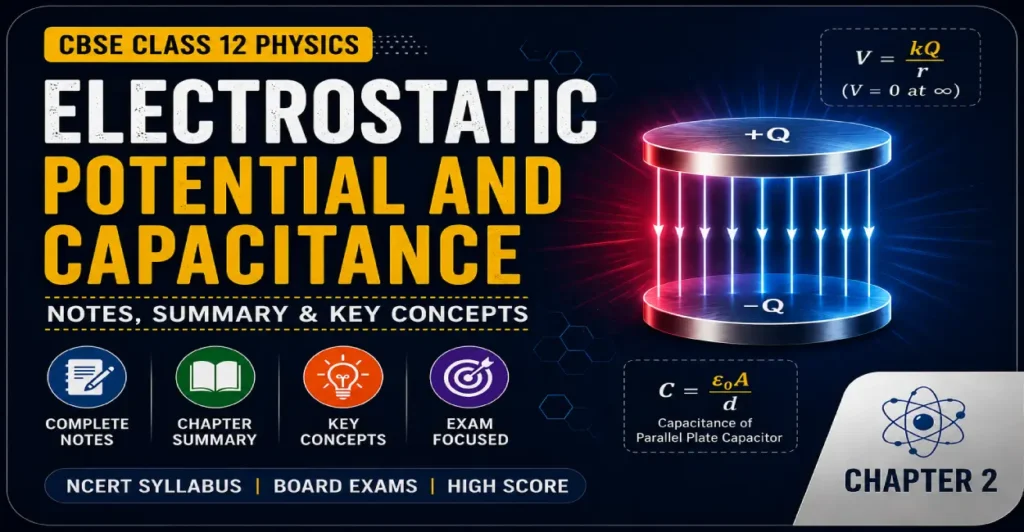
Electrostatic Potential and Capacitance is one of the most important chapters in CBSE Class 12 Physics. This chapter explains how electrical energy is related to electric charges and electric fields. Students learn about electric potential, potential difference, equipotential surfaces, capacitors, capacitance, and energy stored in capacitors.
Table of Contents
- Electrostatic Potential and Capacitance Class 12 Overview
- Electrostatic Potential and Capacitance Summary and Key Concepts
- Electrostatic Potential and Capacitance Important Concepts and NCERT Notes
- Electrostatic Potential and Capacitance Important Terms, Formula Sheet and Diagrams
- Electrostatic Potential and Capacitance Revision Notes and Board Exam Preparation
- 5-Minute Revision Notes
- Common Mistakes Students Make
- Preparation Tips for Board Exams
- What is electrostatic potential in Class 12 Physics?
- What is the difference between electric potential and potential difference?
- What is capacitance?
- What factors affect the capacitance of a capacitor?
- Why is the Electrostatic Potential and Capacitance chapter important?
- What are the most important formulas from Electrostatic Potential and Capacitance?
These Electrostatic Potential and Capacitance Notes help students understand concepts quickly and prepare effectively for school exams, unit tests, annual exams, and CBSE board examinations. Since many numerical and theory-based questions are asked from this chapter every year, it is considered a highly scoring chapter.
Electrostatic Potential and Capacitance Class 12 Overview
| Particular | Details |
| Board | CBSE |
| Class | 12 |
| Subject | Physics |
| Chapter Number | 2 |
| Chapter Name | Electrostatic Potential and Capacitance |
| Important Topics | Electric Potential, Potential Difference, Equipotential Surface, Capacitors, Capacitance, Dielectrics |
| Exam Importance | Very High |
| Question Types Asked | Numericals, Derivations, Theory Questions, Diagrams |
Electrostatic Potential and Capacitance Summary and Key Concepts
In the previous chapter, students studied electric charges and electric fields. This chapter introduces electric potential, which provides an energy-based approach to understanding electrical phenomena.
Electric potential represents the work done in bringing a unit positive charge from infinity to a specific point. The concept makes many calculations easier because potential is a scalar quantity.
The chapter also explains potential difference, potential due to point charges, equipotential surfaces, and electric dipoles. Another major topic is capacitance, which describes the ability of a capacitor to store electric charge.
Important concepts covered in this chapter include:
- Electric Potential
- Potential Difference
- Potential Due to Point Charge
- Potential Due to Multiple Charges
- Equipotential Surfaces
- Electric Dipole Potential
- Capacitors
- Capacitance
- Parallel Plate Capacitor
- Combination of Capacitors
- Energy Stored in a Capacitor
- Dielectric Materials
Understanding these concepts helps students solve numerical problems and score well in board examinations.
Electrostatic Potential and Capacitance Important Concepts and NCERT Notes
Electric Potential and Potential Difference
Electric potential at a point is defined as the work done in bringing a unit positive charge from infinity to that point.
Formula:
V = W/q
Where:
- V = Electric Potential
- W = Work Done
- q = Charge
Important Points:
- Electric potential is a scalar quantity.
- SI unit of electric potential is Volt (V).
- It represents electrical energy per unit charge.
Potential difference is the difference in electric potential between two points.
Formula:
Potential Difference = Work Done/Charge
Important Exam Tip:
CBSE frequently asks definitions and numerical questions based on electric potential and potential difference.
Potential Due to Charges and Equipotential Surfaces
The potential due to a point charge is calculated using:
V = kQ/r
Where:
- Q = Charge
- r = Distance from charge
- k = Electrostatic constant
Important Points:
- Potential decreases as distance increases.
- Positive charge produces positive potential.
- Negative charge produces negative potential.
For multiple charges:
Net Potential = V₁ + V₂ + V₃ + …
Since potential is scalar, algebraic addition is used instead of vector addition.
An equipotential surface is a surface where every point has the same electric potential.
Important Features:
- No work is done while moving a charge along an equipotential surface.
- Electric field is always perpendicular to the equipotential surface.
- Two equipotential surfaces never intersect.
Electric Dipole, Capacitors and Capacitance
An electric dipole consists of two equal and opposite charges separated by a small distance.
Potential due to an electric dipole:
V = kp cosθ/r²
Important Points:
- Depends on dipole moment.
- Depends on angle θ.
- Decreases rapidly with distance.
A capacitor is a device used to store electric charge and electrical energy.
Common Applications:
- Camera flash units
- Power supplies
- Electronic circuits
- Communication devices
Capacitance is the ability of a capacitor to store charge.
Formula:
C = Q/V
Where:
- C = Capacitance
- Q = Charge
- V = Potential Difference
Important Points:
- SI unit is Farad (F).
- Larger capacitance means greater charge storage.
For a parallel plate capacitor:
C = ε₀A/d
Where:
- A = Area of plates
- d = Distance between plates
- ε₀ = Permittivity of free space
Capacitance increases with larger plate area and decreases with greater plate separation.
Capacitor Combinations, Energy Storage and Dielectrics
When capacitors are connected in series:
1/C = 1/C1 + 1/C2 + 1/C3
Important Points:
- Equivalent capacitance decreases.
- Charge remains the same on all capacitors.
When capacitors are connected in parallel:
C = C1 + C2 + C3
Important Points:
- Equivalent capacitance increases.
- Potential difference remains the same.
Energy stored in a capacitor is:
U = (1/2)CV²
Alternative forms:
U = (1/2)QV
U = Q²/(2C)
Important Points:
- Energy is stored in the electric field.
- Frequently used in board examination numericals.
A dielectric is an insulating material placed between capacitor plates.
Formula:
C = Kε₀A/d
Where:
- K = Dielectric Constant
Effects of Dielectric:
- Increases capacitance
- Reduces electric field strength
- Allows more energy storage
Electrostatic Potential and Capacitance Important Terms, Formula Sheet and Diagrams
Important Terms and Definitions
| Term | Meaning |
| Electric Potential | Work done per unit charge |
| Potential Difference | Difference in potential between two points |
| Equipotential Surface | Surface having same potential |
| Capacitor | Device used to store charge |
| Capacitance | Ability to store charge |
| Dielectric | Insulating material placed between capacitor plates |
| Farad | SI unit of capacitance |
| Volt | SI unit of electric potential |
Formula Sheet – Electrostatic Potential and Capacitance
| Formula Name | Formula | Use |
| Electric Potential | V = W/q | Potential calculation |
| Point Charge Potential | V = kQ/r | Potential due to charge |
| Dipole Potential | V = kp cosθ/r² | Potential due to dipole |
| Capacitance | C = Q/V | Charge storage |
| Parallel Plate Capacitor | C = ε₀A/d | Capacitance calculation |
| Series Combination | 1/C = 1/C1 + 1/C2 + 1/C3 | Equivalent capacitance |
| Parallel Combination | C = C1 + C2 + C3 | Equivalent capacitance |
| Energy Stored | U = (1/2)CV² | Energy calculation |
| Energy Stored | U = (1/2)QV | Energy calculation |
| Energy Stored | U = Q²/(2C) | Energy calculation |
| Dielectric Capacitor | C = Kε₀A/d | Effect of dielectric |
Important Diagrams to Practice
Students should regularly practice the following diagrams:
- Equipotential surfaces around a point charge
- Electric field lines and equipotential surfaces
- Electric dipole with field lines
- Parallel plate capacitor
- Capacitor with dielectric slab
These diagrams are frequently asked in board examinations and derivation-based questions.
Electrostatic Potential and Capacitance Revision Notes and Board Exam Preparation
5-Minute Revision Notes
- Electric potential is work done per unit charge.
- SI unit of electric potential is Volt.
- Potential is a scalar quantity.
- Equipotential surfaces have constant potential.
- No work is done along an equipotential surface.
- Capacitors store charge and electrical energy.
- Capacitance is given by C = Q/V.
- Series combination decreases capacitance.
- Parallel combination increases capacitance.
- Dielectric materials increase capacitance.
- Energy stored in a capacitor is U = (1/2)CV².
Common Mistakes Students Make
- Confusing electric field with electric potential.
- Using vector addition for potential calculations.
- Forgetting the unit of capacitance.
- Mixing series and parallel capacitor formulas.
- Ignoring dielectric constant in numerical problems.
- Using incorrect energy formulas.
- Drawing capacitor diagrams incorrectly.
Preparation Tips for Board Exams
- Learn all formulas thoroughly.
- Revise derivations of parallel plate capacitors.
- Practice NCERT examples and exercises.
- Solve previous year board questions.
- Focus on capacitor combinations and energy storage numericals.
- Understand equipotential surfaces clearly.
- Draw neat and properly labelled diagrams.
- Prepare a one-page formula sheet for quick revision.
Electrostatic Potential and Capacitance is one of the highest-scoring chapters in Class 12 Physics. A strong understanding of formulas, capacitor concepts, and derivations can help students perform exceptionally well in school and board examinations.
Last updated on

Santosh Nishad
I am Santosh Kumar, an Academic Writer and Subject Matter Expert with a strong background in Physics, Mathematics, and General Science. I hold an M.Sc. in Physics from the University of Delhi and have extensive experience in developing educational content for school and competitive exam students. My expertise includes creating study notes, mock tests, question banks, practice papers, and curriculum-aligned learning materials. I am passionate about simplifying complex concepts into easy-to-understand content that helps students achieve academic excellence and build strong conceptual understanding.