
Electric Charges and Fields Notes, Summary & Key Concepts | CBSE Class 12 Physics Chapter 1
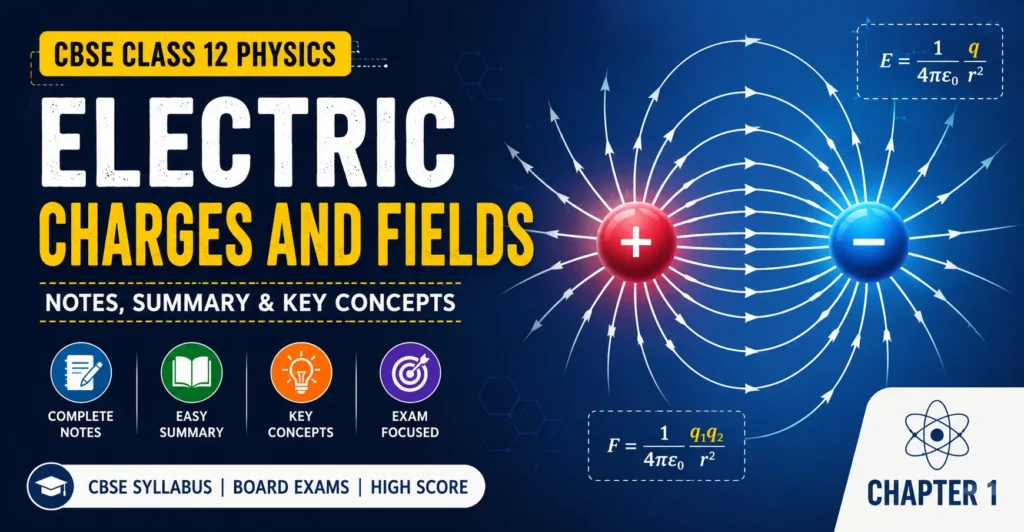
Electric Charges and Fields Notes are very important for CBSE Class 12 Physics because this chapter forms the foundation of Electrostatics. Students learn about electric charge, Coulomb’s law, electric field, electric field lines, electric flux, and Gauss’s law. Questions from this chapter frequently appear in school exams, board exams, and competitive exams like JEE and NEET. These notes provide a quick and easy understanding of all important concepts for effective revision.
Table of Contents
- Electric Charges and Fields Class 12 Overview
- Electric Charges and Fields Summary for Quick Understanding
- CBSE Class 12 Electric Charges and Fields Important Concepts and Notes
- Electric Charges and Fields Important Terms and Definitions
- Electric Charges and Fields Formula Sheet and Important Equations
- Electric Charges and Fields Important Diagrams and Revision Notes
- Common Mistakes Students Make in Electric Charges and Fields
- Electric Charges and Fields Board Exam Preparation Tips
Electric Charges and Fields Class 12 Overview
| Particular | Details |
| Board | CBSE |
| Class | 12 |
| Subject | Physics |
| Chapter Name | Electric Charges and Fields |
| Important Topics | Electric Charge, Coulomb’s Law, Electric Field, Electric Field Lines, Electric Flux, Gauss’s Law |
| Exam Importance | Very High |
| Question Types Asked | Definitions, Derivations, Numericals, Diagrams, Concept-Based Questions |
Electric Charges and Fields Summary for Quick Understanding
Electric charge is a basic property of matter. Charges are of two types: positive and negative. Similar charges repel each other, while unlike charges attract each other.
The interaction between charges is explained by Coulomb’s Law. It states that the force between two point charges is directly proportional to the product of their charges and inversely proportional to the square of the distance between them.
An electric field is the region around a charged object where another charge experiences force. The strength of the electric field depends on the amount of charge and distance from it.
Important concepts covered in this chapter:
- Properties of electric charges
- Conservation of charge
- Quantization of charge
- Coulomb’s Law
- Electric field intensity
- Electric field lines
- Electric dipole
- Electric flux
- Gauss’s Law
These concepts help students understand how charged particles interact in nature.
CBSE Class 12 Electric Charges and Fields Important Concepts and Notes
Electric Charge, Coulomb’s Law and Electric Field
What is Electric Charge?
Electric charge is a physical property that causes attraction or repulsion between objects.
Important Properties of Charge
- Charges are of two types: positive and negative.
- Like charges repel.
- Unlike charges attract.
- Charge is conserved.
- Charge is quantized.
Coulomb’s Law
The electrostatic force between two point charges is given by:
F = k(q₁q₂/r²)
Important Points
- Force increases with charge.
- Force decreases with distance.
- The force acts along the line joining the charges.
Exam Tip
Board exams often ask derivations and applications of Coulomb’s Law.
Electric Field
Electric field at a point is the force experienced by a unit positive test charge placed at that point.
Electric field intensity:
E = F/q
Quick Revision Point
Electric field tells how strongly a charge influences the space around it.
Electric Field Lines, Electric Dipole and Gauss’s Law
Electric Field Lines
Electric field lines are imaginary lines used to represent electric fields.
Important characteristics:
- Start from positive charge.
- End at negative charge.
- Never intersect each other.
- Closer lines indicate a stronger field.
Electric Dipole
An electric dipole consists of two equal and opposite charges separated by a small distance.
Dipole Moment:
p = q × 2a
Where:
- q = magnitude of charge
- 2a = separation between charges
Electric Flux
Electric flux measures the number of electric field lines passing through a surface.
Gauss’s Law
According to Gauss’s Law, the total electric flux through a closed surface equals the net charge enclosed divided by the permittivity of free space.
Exam Tip
Applications of Gauss’s Law and electric field line diagrams are frequently asked in board examinations.
Quick Revision Point
Gauss’s Law simplifies calculations of electric fields for symmetrical charge distributions.
Electric Charges and Fields Important Terms and Definitions
| Term | Meaning |
| Electric Charge | Property responsible for electric interaction |
| Coulomb | SI unit of charge |
| Electric Field | Region where a charge experiences force |
| Electric Field Intensity | Force per unit charge |
| Electric Flux | Measure of field lines through a surface |
| Electric Dipole | Pair of equal and opposite charges |
| Dipole Moment | Strength of an electric dipole |
| Permittivity | Property affecting electric force in a medium |
| Gauss Surface | Imaginary closed surface used in Gauss’s Law |
| Electrostatics | Study of stationary charges |
Electric Charges and Fields Formula Sheet and Important Equations
| Formula Name | Formula | Use |
| Coulomb’s Law | F = k(q₁q₂/r²) | Force between charges |
| Electric Field | E = F/q | Calculate field intensity |
| Electric Field due to Point Charge | E = kq/r² | Field at a distance r |
| Dipole Moment | p = q × 2a | Strength of dipole |
| Electric Flux | Φ = E·A·cosθ | Flux through a surface |
| Gauss’s Law | Φ = q/ε₀ | Total flux through closed surface |
Electric Charges and Fields Important Diagrams and Revision Notes
Important Diagrams to Practice
Students should regularly practice:
- Electric field lines of positive charge
- Electric field lines of negative charge
- Field lines between unlike charges
- Field lines between like charges
- Electric dipole diagram
- Gaussian surface around point charge
These diagrams are commonly asked in board exams and carry easy marks.
Quick Revision Notes
| Topic | Key Point |
| Charge | Positive and negative |
| Coulomb’s Law | Force ∝ q₁q₂/r² |
| Electric Field | Force per unit charge |
| Field Lines | Never intersect |
| Dipole | Two equal opposite charges |
| Dipole Moment | p = q × 2a |
| Electric Flux | Field through surface |
| Gauss’s Law | Flux depends on enclosed charge |
5-Minute Revision
- Like charges repel; unlike charges attract.
- Charge is conserved and quantized.
- Electric field intensity is measured in N/C.
- Electric field lines never cross.
- Dipole moment direction is from negative to positive charge.
- Electric flux depends on electric field and area.
- Gauss’s Law relates electric flux to enclosed charge.
Common Mistakes Students Make in Electric Charges and Fields
- Confusing electric force with electric field.
- Using wrong units in numericals.
- Forgetting inverse square relation in Coulomb’s Law.
- Drawing incorrect electric field lines.
- Ignoring direction of electric field vectors.
- Using wrong sign conventions in charge calculations.
- Memorizing formulas without understanding their applications.
Electric Charges and Fields Board Exam Preparation Tips
- Learn all formulas and their units carefully.
- Practice electric field line diagrams daily.
- Revise properties of electric charges regularly.
- Focus on Coulomb’s Law derivations and applications.
- Understand the physical meaning of electric flux.
- Solve NCERT examples and exercises thoroughly.
- Prepare short notes for quick revision before exams.
- Pay special attention to Gauss’s Law and electric dipole concepts.
For scoring well in CBSE board exams, focus on conceptual clarity rather than rote learning. Regular practice of derivations, diagrams, and formula-based questions will help you achieve better marks in Electric Charges and Fields.
Last updated on

Santosh Nishad
I am Santosh Kumar, an Academic Writer and Subject Matter Expert with a strong background in Physics, Mathematics, and General Science. I hold an M.Sc. in Physics from the University of Delhi and have extensive experience in developing educational content for school and competitive exam students. My expertise includes creating study notes, mock tests, question banks, practice papers, and curriculum-aligned learning materials. I am passionate about simplifying complex concepts into easy-to-understand content that helps students achieve academic excellence and build strong conceptual understanding.