
Wave Optics Notes, Summary & Key Concepts | CBSE Class 12 Physics
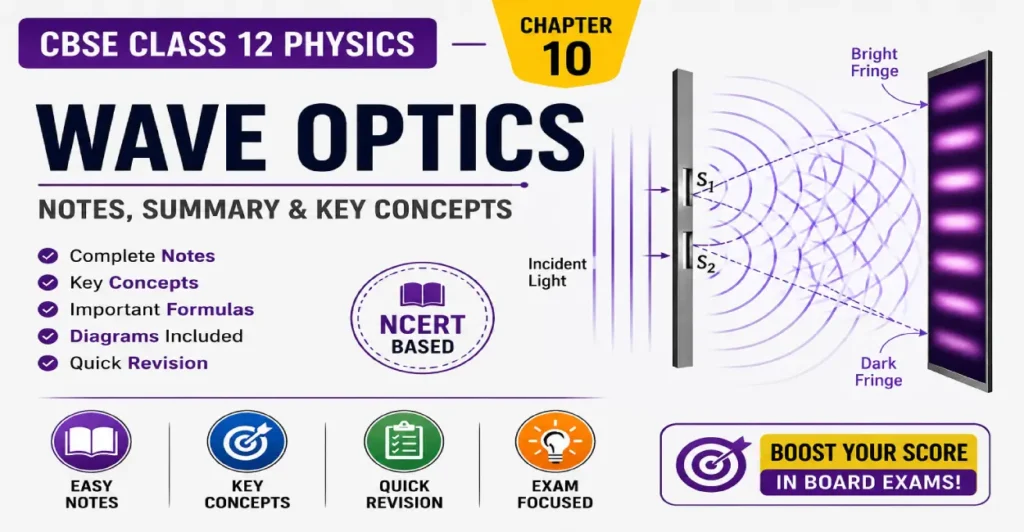
Wave Optics is an important chapter in CBSE Class 12 Physics that explains the wave nature of light. Unlike Ray Optics, which treats light as rays travelling in straight lines, Wave Optics explains phenomena such as interference, diffraction, and polarization that can only be understood using the wave model of light.
Table of Contents
- Wave Optics Class 12 Overview
- Wave Optics Summary and Important Concepts
- Interference of Light and Young’s Double Slit Experiment Notes
- Diffraction and Polarization of Light Notes
- Wave Optics Formula Sheet, Important Terms and Revision Notes
- Important Terms and Definitions
- Formula Sheet
- Important Diagrams to Practice
- 5-Minute Revision Notes
- Common Mistakes Students Make
- Preparation Tips for Board Exams
- What is Wave Optics?
- What is interference of light?
- What is diffraction of light?
- What is polarization of light?
- What is Young’s Double Slit Experiment?
- Why is Wave Optics important in Class 12 Physics?
- Is Wave Optics important for JEE, NEET, and CUET?
These Wave Optics Notes are useful for school exams, unit tests, annual examinations, and CBSE board exams. The chapter is largely theory-based but also contains important formulas, derivations, and diagrams. A strong understanding of Huygens’ Principle, Young’s Double Slit Experiment, diffraction, and polarization can help students score well in board examinations.
Wave Optics Class 12 Overview
| Particular | Details |
| Board | CBSE |
| Class | 12 |
| Subject | Physics |
| Chapter Number | 10 |
| Chapter Name | Wave Optics |
| Important Topics | Huygens’ Principle, Interference, YDSE, Diffraction, Polarization |
| Exam Importance | High |
| Question Types Asked | Theory, Numericals, Derivations, Diagrams |
Wave Optics Summary and Important Concepts
Wave Optics explains light as a wave phenomenon. It helps us understand how light behaves when it passes through narrow openings or around obstacles. The chapter provides strong evidence that light has wave-like properties.
The foundation of Wave Optics is Huygens’ Principle. According to this principle, every point on a wavefront acts as a source of secondary wavelets. These wavelets spread in all directions, and the new wavefront is formed by the envelope of these secondary wavelets.
Important points about Huygens’ Principle:
- Proposed by Christiaan Huygens.
- Explains reflection and refraction of light.
- Helps understand wave propagation.
- Forms the basis of wave optics.
A wavefront is a surface joining all points that vibrate in the same phase.
Types of wavefronts:
| Wavefront Type | Produced By |
| Plane Wavefront | Very distant source |
| Spherical Wavefront | Point source |
| Cylindrical Wavefront | Linear source |
Important properties:
- Wavefronts are always perpendicular to the direction of propagation.
- Light rays are normal to the wavefront.
- Reflection and refraction can be explained using Huygens’ Principle.
Using Huygens’ Principle:
- Reflection follows the law: Angle of incidence = Angle of reflection.
- Refraction follows Snell’s Law because light changes speed when entering another medium.
Interference of Light and Young’s Double Slit Experiment Notes
Interference is the redistribution of light intensity when two coherent light waves overlap. It is one of the strongest proofs of the wave nature of light.
Conditions for interference:
- Sources must be coherent.
- Sources must have the same frequency.
- Phase difference must remain constant.
There are two types of interference.
Constructive Interference
Constructive interference occurs when two waves meet in the same phase.
Condition:
Path Difference = nλ
Where:
- n = 0, 1, 2, 3…
- λ = Wavelength
Result:
- Bright Fringe is formed.
- Intensity becomes maximum.
Destructive Interference
Destructive interference occurs when two waves meet in opposite phases.
Condition:
Path Difference = (2n + 1)λ/2
Result:
- Dark Fringe is formed.
- Intensity becomes minimum.
Young’s Double Slit Experiment (YDSE) provides direct evidence for the wave nature of light.
Experimental setup:
- Monochromatic light source
- Two narrow slits
- Screen
Observations:
- Alternate bright and dark fringes appear on the screen.
- Demonstrates interference of light.
Fringe Width Formula:
β = λD/d
Where:
- β = Fringe Width
- λ = Wavelength
- D = Distance between slit and screen
- d = Distance between slits
Important points:
- Fringe width increases with wavelength.
- Fringe width increases with screen distance.
- Fringe width decreases when slit separation increases.
Diffraction and Polarization of Light Notes
Diffraction is the bending and spreading of light around obstacles or through narrow openings.
Important characteristics:
- Most noticeable when obstacle size is comparable to wavelength.
- Produces alternate bright and dark regions.
- Confirms the wave nature of light.
Difference Between Interference and Diffraction
| Interference | Diffraction |
| Produced by two coherent sources | Produced by one slit or obstacle |
| Fringe intensity remains nearly constant | Fringe intensity decreases away from center |
| Requires two wave sources | Requires one aperture |
| Fringes are sharp and distinct | Central maximum is broader |
Polarization is another important phenomenon in wave optics.
Polarization is the process of restricting vibrations of light waves to a single plane.
Important points:
- Only transverse waves can be polarized.
- Polarization proves that light is transverse in nature.
- Longitudinal waves cannot be polarized.
Methods of polarization:
- Reflection
- Refraction
- Polaroids
Polaroids are special materials that allow vibrations only in one plane.
Applications of Polaroids:
- Sunglasses
- Camera filters
- LCD screens
- 3D movie glasses
Brewster’s Law relates the polarizing angle and refractive index.
Formula:
tan ip = n
Where:
- ip = Polarizing Angle
- n = Refractive Index
This law is frequently asked in theory-based board questions.
Wave Optics Formula Sheet, Important Terms and Revision Notes
Important Terms and Definitions
| Term | Meaning |
| Wavefront | Surface joining points in the same phase |
| Secondary Wavelets | Small waves produced by wavefront points |
| Interference | Redistribution of light intensity |
| Constructive Interference | Formation of bright fringes |
| Destructive Interference | Formation of dark fringes |
| Diffraction | Bending of light around obstacles |
| Polarization | Restriction of light vibrations |
| Polaroid | Device producing polarized light |
| Coherent Sources | Sources having constant phase difference |
| Fringe Width | Distance between consecutive fringes |
Formula Sheet
| Formula Name | Formula |
| Fringe Width | β = λD/d |
| Constructive Interference | Path Difference = nλ |
| Destructive Interference | Path Difference = (2n + 1)λ/2 |
| Brewster’s Law | tan ip = n |
| Refractive Index | n = c/v |
Important Diagrams to Practice
Students should practice:
- Plane Wavefront
- Spherical Wavefront
- Huygens’ Construction
- Reflection Using Huygens’ Principle
- Refraction Using Huygens’ Principle
- Young’s Double Slit Experiment
- Bright and Dark Fringe Formation
- Single Slit Diffraction Pattern
- Polarization by Polaroid
- Brewster’s Angle Diagram
5-Minute Revision Notes
- Huygens’ Principle explains wave propagation.
- Every point on a wavefront acts as a source of secondary wavelets.
- Interference occurs due to superposition of waves.
- Constructive interference produces bright fringes.
- Destructive interference produces dark fringes.
- YDSE proves the wave nature of light.
- Fringe width = λD/d.
- Diffraction is bending of light around obstacles.
- Polarization proves light is transverse.
- Polaroids produce polarized light.
- Brewster’s Law: tan ip = n.
Common Mistakes Students Make
- Confusing interference and diffraction.
- Forgetting conditions for coherent sources.
- Using incorrect fringe width formula.
- Mixing constructive and destructive interference conditions.
- Confusing polarization with diffraction.
- Forgetting that only transverse waves can be polarized.
- Incorrect interpretation of YDSE results.
- Errors in diagram labeling.
Preparation Tips for Board Exams
- Learn Huygens’ Principle thoroughly.
- Understand Young’s Double Slit Experiment in detail.
- Memorize the fringe width formula.
- Learn differences between interference and diffraction.
- Revise polarization concepts regularly.
- Practice all important diagrams.
- Solve previous year CBSE questions.
- Focus on NCERT theory questions.
- Prepare short notes for quick revision.
- Revise important formulas daily.
Wave Optics is a highly scoring chapter in CBSE Class 12 Physics. A strong understanding of interference, diffraction, polarization, Huygens’ Principle, and Young’s Double Slit Experiment can help students score excellent marks in both theory and numerical questions in the CBSE board examination.
Last updated on

Sanjeev Gupta
Writes about exams, syllabus, date sheets and results for students across India.