
Ray Optics and Optical Instruments Notes, Summary & Key Concepts | CBSE Class 12 Physics
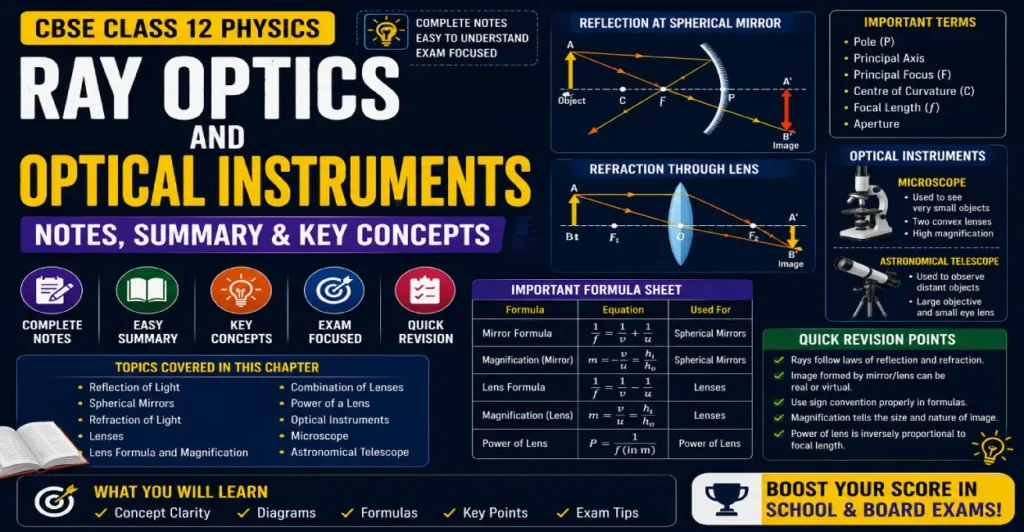
Ray Optics and Optical Instruments is one of the most important chapters in CBSE Class 12 Physics. This chapter explains the behavior of light using the ray model and helps students understand reflection, refraction, mirrors, lenses, prisms, optical fibers, and optical instruments. Many concepts from this chapter are used in daily life, including spectacles, cameras, microscopes, telescopes, and fiber optic communication.
Table of Contents
- Ray Optics and Optical Instruments Class 12 Overview
- Ray Optics and Optical Instruments Summary and Important Concepts
- Total Internal Reflection, Optical Fibre and Lens Notes
- Prism, Dispersion and Optical Instruments Notes
- Ray Optics and Optical Instruments Formula Sheet, Important Terms and Revision Notes
- Important Terms and Definitions
- Formula Sheet
- Important Diagrams to Practice
- 5-Minute Revision Notes
- Common Mistakes Students Make
- Preparation Tips for Board Exams
- FAQ title
- What are electromagnetic waves in Class 12 Physics?
- What are the types of electromagnetic waves?
- Do electromagnetic waves require a medium?
- What is the speed of electromagnetic waves?
- What is the electromagnetic spectrum?
- What are the uses of electromagnetic waves?
- Why is this chapter important for exams?
These Ray Optics and Optical Instruments Notes are designed for quick learning, revision, and board exam preparation. The chapter contains several important formulas, derivations, ray diagrams, and numerical problems, making it one of the highest-weightage chapters in Class 12 Physics.
Ray Optics and Optical Instruments Class 12 Overview
| Particular | Details |
| Board | CBSE |
| Class | 12 |
| Subject | Physics |
| Chapter Number | 9 |
| Chapter Name | Ray Optics and Optical Instruments |
| Important Topics | Reflection, Refraction, Mirrors, Lenses, Prism, Optical Instruments |
| Exam Importance | Very High |
| Question Types Asked | Numericals, Theory, Derivations, Diagrams |
Ray Optics and Optical Instruments Summary and Important Concepts
Ray optics studies light as rays travelling in straight lines. It explains how light behaves when it encounters mirrors, lenses, prisms, and different media.
The first important phenomenon is reflection of light, which occurs when light strikes a surface and bounces back into the same medium.
Laws of Reflection:
- Angle of incidence equals angle of reflection.
- Incident ray, reflected ray, and normal lie in the same plane.
Spherical mirrors are classified into:
- Concave Mirror (Converging Mirror)
- Convex Mirror (Diverging Mirror)
Important mirror relationship:
R = 2f
Where:
- R = Radius of Curvature
- f = Focal Length
Mirror Formula:
1/f = 1/v + 1/u
Mirror Magnification:
m = -v/u
Important points:
- Concave mirrors can form real and virtual images.
- Convex mirrors always form virtual and diminished images.
- Sign convention is extremely important while solving numericals.
Another important concept is refraction of light. Refraction is the bending of light when it passes from one medium to another due to a change in speed.
According to Snell’s Law:
n₁ sin i = n₂ sin r
Refractive Index Formula:
n = c/v
Where:
- n = Refractive Index
- c = Speed of Light in Vacuum
- v = Speed of Light in Medium
Important points:
- Light bends towards the normal in a denser medium.
- Light bends away from the normal in a rarer medium.
- Higher refractive index means greater optical density.
Total Internal Reflection, Optical Fibre and Lens Notes
Total Internal Reflection (TIR) is one of the most important topics in this chapter. It occurs when light travelling from a denser medium to a rarer medium strikes the boundary at an angle greater than the critical angle.
Conditions for Total Internal Reflection:
- Light must travel from denser to rarer medium.
- Angle of incidence must exceed the critical angle.
Applications of TIR:
- Optical Fibres
- Prism Binoculars
- Endoscopy
- Telecommunication Systems
Optical fibres are thin transparent fibres that transmit light through repeated total internal reflection.
Major uses include:
- Internet communication
- Medical imaging
- Telecommunication networks
Lenses are another important part of ray optics.
Types of lenses:
| Lens Type | Nature |
| Convex Lens | Converging Lens |
| Concave Lens | Diverging Lens |
Lens Formula:
1/f = 1/v – 1/u
Lens Magnification:
m = v/u
Important points:
- Convex lenses converge light rays.
- Concave lenses diverge light rays.
- Lens formula is frequently used in board exam numericals.
Power of a Lens:
P = 1/f
Where:
- P = Power (Dioptre)
- f = Focal Length (in metre)
Important points:
- Convex lens has positive power.
- Concave lens has negative power.
Lens Maker’s Formula:
1/f = (n – 1)(1/R₁ – 1/R₂)
This formula relates the focal length of a lens to its refractive index and radii of curvature.
Prism, Dispersion and Optical Instruments Notes
A prism is a transparent refracting medium bounded by two inclined plane surfaces.
Important Prism Formula:
δm = (n – 1)A
Where:
- δm = Minimum Deviation
- n = Refractive Index
- A = Angle of Prism
One of the most important effects produced by a prism is dispersion.
Dispersion is the splitting of white light into its constituent colours.
Important points:
- Violet light deviates the most.
- Red light deviates the least.
- Rainbow formation is a natural example of dispersion.
The chapter also introduces optical instruments used for magnification and observation.
Simple Microscope
- Uses a convex lens.
- Produces magnified images.
- Used for reading fine print and laboratory work.
Compound Microscope
- Uses objective and eyepiece lenses.
- Produces highly magnified images.
- Used in biological and scientific studies.
Astronomical Telescope
- Used to observe distant celestial objects.
- Consists of an objective lens and eyepiece.
- Widely used in astronomy.
Human Eye Basics
Important parts:
- Cornea
- Iris
- Pupil
- Retina
- Eye Lens
- Optic Nerve
Important fact:
Least Distance of Distinct Vision = 25 cm
Power of accommodation is the ability of the eye lens to change its focal length and focus on objects at different distances.
Ray Optics and Optical Instruments Formula Sheet, Important Terms and Revision Notes
Important Terms and Definitions
| Term | Meaning |
| Reflection | Bouncing back of light |
| Refraction | Bending of light |
| Refractive Index | Measure of optical density |
| Critical Angle | Angle for total internal reflection |
| Focal Length | Distance between focus and optical centre |
| Power of Lens | Converging or diverging ability of lens |
| Dispersion | Splitting of white light |
| Prism | Transparent refracting medium |
| Magnification | Enlargement of image |
| Optical Fibre | Light-guiding fibre |
Formula Sheet
| Formula Name | Formula |
| Mirror Formula | 1/f = 1/v + 1/u |
| Mirror Magnification | m = -v/u |
| Snell’s Law | n₁ sin i = n₂ sin r |
| Refractive Index | n = c/v |
| Lens Formula | 1/f = 1/v – 1/u |
| Lens Magnification | m = v/u |
| Power of Lens | P = 1/f |
| Lens Maker’s Formula | 1/f = (n – 1)(1/R₁ – 1/R₂) |
| Prism Formula | δm = (n – 1)A |
| Radius-Focal Length Relation | R = 2f |
Important Diagrams to Practice
Students should regularly practice:
- Reflection from Plane Mirror
- Concave Mirror Ray Diagram
- Convex Mirror Ray Diagram
- Refraction Through Glass Slab
- Total Internal Reflection
- Convex Lens Ray Diagram
- Concave Lens Ray Diagram
- Prism Diagram
- Compound Microscope
- Astronomical Telescope
- Structure of Human Eye
5-Minute Revision Notes
- Reflection follows two laws.
- Angle of incidence equals angle of reflection.
- Refraction occurs due to change in speed.
- Snell’s Law: n₁ sin i = n₂ sin r.
- Total internal reflection occurs from denser to rarer medium.
- Optical fibre works on total internal reflection.
- Mirror formula: 1/f = 1/v + 1/u.
- Lens formula: 1/f = 1/v – 1/u.
- Power of lens = 1/f.
- Convex lens converges light.
- Concave lens diverges light.
- Prism disperses white light.
- Violet deviates most and red deviates least.
- Compound microscope provides high magnification.
- Telescope is used for observing distant objects.
Common Mistakes Students Make
- Using incorrect sign convention.
- Confusing concave and convex mirrors.
- Confusing convex and concave lenses.
- Forgetting lens and mirror formulas.
- Mixing focal length and radius of curvature.
- Applying Snell’s Law incorrectly.
- Using wrong magnification formulas.
- Forgetting prism deviation concepts.
Preparation Tips for Board Exams
- Learn all formulas thoroughly.
- Practice ray diagrams regularly.
- Master sign convention.
- Solve mirror and lens numericals daily.
- Revise total internal reflection concepts.
- Practice prism-related questions.
- Learn optical instrument working principles.
- Focus on NCERT examples and derivations.
- Solve previous year CBSE questions.
- Prepare a separate formula sheet for quick revision.
Ray Optics and Optical Instruments is one of the most important and highest-weightage chapters in CBSE Class 12 Physics. A strong understanding of mirrors, lenses, refraction, prisms, total internal reflection, and optical instruments can help students score excellent marks in both theory and numerical sections of the CBSE board examination.
Last updated on

Sanjeev Gupta
Writes about exams, syllabus, date sheets and results for students across India.