
Moving Charges and Magnetism Notes, Summary & Key Concepts | CBSE Class 12 Physics
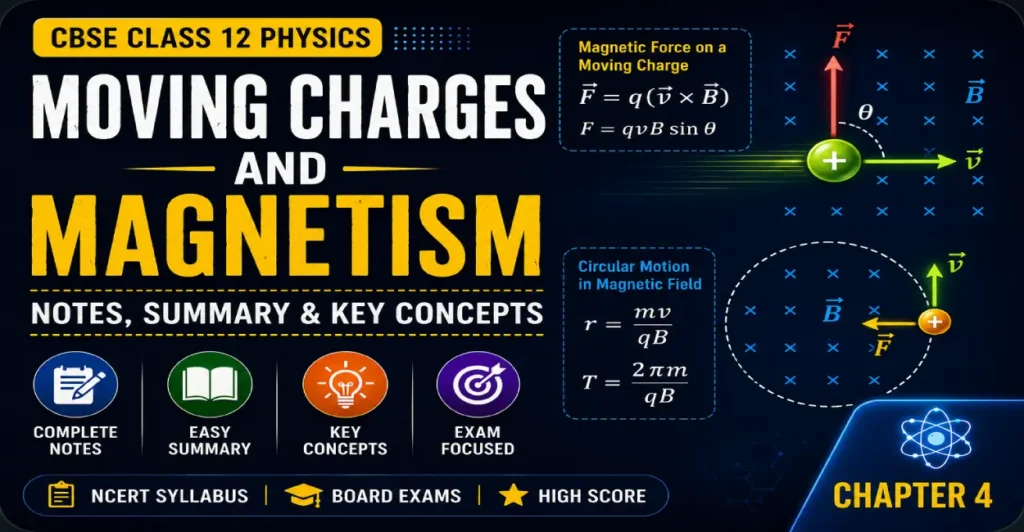
Moving Charges and Magnetism is an important chapter in CBSE Class 12 Physics. This chapter explains how moving electric charges create magnetic fields and how magnetic fields affect moving charges. Students learn about magnetic force, motion of charged particles, Biot-Savart Law, Ampere’s Circuital Law, solenoids, toroids, cyclotrons, and force on current-carrying conductors.
Table of Contents
These Moving Charges and Magnetism Notes help students prepare for school exams, unit tests, annual exams, and CBSE board examinations. The chapter contains important derivations, diagrams, conceptual questions, and numericals that are frequently asked in board exams.
Moving Charges and Magnetism Class 12 Overview
| Particular | Details |
| Board | CBSE |
| Class | 12 |
| Subject | Physics |
| Chapter Number | 4 |
| Chapter Name | Moving Charges and Magnetism |
| Important Topics | Magnetic Force, Biot-Savart Law, Ampere’s Law, Cyclotron, Solenoid, Toroid |
| Exam Importance | Very High |
| Question Types Asked | Numericals, Theory, Derivations, Diagrams |
Moving Charges and Magnetism Summary and Important Concepts
Electric charges at rest produce electric fields, while moving charges produce both electric and magnetic fields. This relationship between electricity and magnetism forms the foundation of this chapter.
A charged particle moving in a magnetic field experiences a magnetic force. The magnitude of this force is given by:
F = qvB sinθ
where q is the charge, v is velocity, B is magnetic field strength, and θ is the angle between velocity and magnetic field.
Important points:
- Magnetic force is maximum when θ = 90°.
- Magnetic force is zero when θ = 0°.
- The force is always perpendicular to the direction of motion.
When a charged particle enters a magnetic field perpendicular to its velocity, it moves in a circular path. The radius of the path is:
r = mv/qB
The time period and frequency of motion are:
T = 2πm/qB
f = qB/2πm
These concepts form the basis of the cyclotron, a device used to accelerate charged particles for scientific and medical applications.
The cyclotron frequency is:
f = qB/2πm
Cyclotrons are used in:
- Nuclear research
- Cancer treatment
- Particle acceleration experiments
Students should clearly understand the circular motion of charged particles because it is frequently tested in CBSE examinations.
Biot-Savart Law, Ampere’s Law and Magnetic Fields Notes
The Biot-Savart Law helps calculate the magnetic field produced by a small current element.
Formula:
dB = (μ₀/4π)(Idl sinθ/r²)
Important observations:
- Magnetic field increases with current.
- Magnetic field decreases with distance.
- Direction is determined using the Right-Hand Thumb Rule.
For a long straight conductor:
B = μ₀I/2πr
Important points:
- Magnetic field lines are circular.
- Magnetic field decreases as distance increases.
- Right-Hand Thumb Rule helps determine field direction.
According to the Right-Hand Thumb Rule:
- Thumb shows current direction.
- Curled fingers show magnetic field direction.
The magnetic field at the center of a circular current loop is:
B = μ₀I/2R
Ampere’s Circuital Law relates magnetic field and current enclosed within a closed path.
Formula:
∮B·dl = μ₀I
This law is especially useful for calculating magnetic fields in symmetrical current distributions such as solenoids and toroids.
Solenoid, Toroid and Force on Current-Carrying Conductors
A solenoid is a long cylindrical coil made by winding insulated wire closely together.
Magnetic field inside a solenoid:
B = μ₀nI
where n is the number of turns per unit length.
Important features:
- Produces a strong magnetic field.
- Magnetic field inside is almost uniform.
- Acts like a bar magnet.
A toroid is a circular solenoid.
Magnetic field inside a toroid:
B = μ₀NI/2πr
Important points:
- Magnetic field remains confined inside the toroid.
- External magnetic field is nearly zero.
- Used in transformers and inductors.
A current-carrying conductor placed in a magnetic field experiences a force.
Formula:
F = BIL sinθ
Important points:
- Maximum force occurs at 90°.
- Basis of electric motors.
- Direction is determined using Fleming’s Left-Hand Rule.
According to Fleming’s Left-Hand Rule:
| Finger | Represents |
| Forefinger | Magnetic Field |
| Middle Finger | Current |
| Thumb | Force/Motion |
The force per unit length between two parallel current-carrying conductors is:
F/L = μ₀I₁I₂/2πd
Where d is the distance between conductors.
Important rule:
- Same direction currents attract.
- Opposite direction currents repel.
Moving Charges and Magnetism Formula Sheet, Important Terms and Revision Notes
Important Terms and Definitions
| Term | Meaning |
| Magnetic Field | Region where magnetic force acts |
| Magnetic Force | Force on moving charge in magnetic field |
| Solenoid | Cylindrical current-carrying coil |
| Toroid | Circular solenoid |
| Cyclotron | Particle accelerator |
| Current Element | Small section of conductor carrying current |
| Lorentz Force | Combined electric and magnetic force |
| Tesla | SI unit of magnetic field |
Formula Sheet
| Formula Name | Formula |
| Magnetic Force | F = qvB sinθ |
| Radius of Circular Path | r = mv/qB |
| Time Period | T = 2πm/qB |
| Frequency | f = qB/2πm |
| Biot-Savart Law | dB = (μ₀/4π)(Idl sinθ/r²) |
| Straight Wire Field | B = μ₀I/2πr |
| Circular Loop Field | B = μ₀I/2R |
| Ampere’s Law | ∮B·dl = μ₀I |
| Solenoid Field | B = μ₀nI |
| Toroid Field | B = μ₀NI/2πr |
| Force on Conductor | F = BIL sinθ |
| Force Between Conductors | F/L = μ₀I₁I₂/2πd |
Important Diagrams
Students should practice:
- Right-Hand Thumb Rule
- Charged Particle in Magnetic Field
- Cyclotron Diagram
- Magnetic Field Around Straight Conductor
- Circular Current Loop
- Solenoid Diagram
- Toroid Diagram
- Fleming’s Left-Hand Rule
- Parallel Current-Carrying Conductors
5-Minute Revision Notes
- Moving charges produce magnetic fields.
- Magnetic force = qvB sinθ.
- Radius of circular path = mv/qB.
- Cyclotron accelerates charged particles.
- Biot-Savart Law gives magnetic field due to current element.
- Ampere’s Law relates magnetic field and current.
- Solenoid produces a strong uniform magnetic field.
- Toroid confines magnetic field within itself.
- Force on conductor = BIL sinθ.
- Parallel currents attract each other.
Common Mistakes Students Make
- Confusing Right-Hand Thumb Rule with Fleming’s Left-Hand Rule.
- Using incorrect angle in magnetic force calculations.
- Forgetting that magnetic force is perpendicular to velocity.
- Using wrong formulas for radius and frequency.
- Confusing solenoid and toroid concepts.
- Making errors in magnetic field direction.
- Ignoring units in numerical problems.
Preparation Tips for Board Exams
- Learn all formulas thoroughly.
- Practice magnetic force numericals daily.
- Revise Biot-Savart Law and Ampere’s Law derivations.
- Draw diagrams neatly with proper labels.
- Practice previous year CBSE questions.
- Focus on cyclotron, solenoid, and toroid concepts.
- Prepare a one-page formula sheet for revision.
Moving Charges and Magnetism is a high-scoring chapter in CBSE Class 12 Physics. Strong understanding of magnetic force, circular motion, Biot-Savart Law, Ampere’s Circuital Law, and current-carrying conductors can help students score excellent marks in board examinations.
Last updated on

Santosh Nishad
I am Santosh Kumar, an Academic Writer and Subject Matter Expert with a strong background in Physics, Mathematics, and General Science. I hold an M.Sc. in Physics from the University of Delhi and have extensive experience in developing educational content for school and competitive exam students. My expertise includes creating study notes, mock tests, question banks, practice papers, and curriculum-aligned learning materials. I am passionate about simplifying complex concepts into easy-to-understand content that helps students achieve academic excellence and build strong conceptual understanding.