
Dual Nature of Radiation and Matter Notes, Summary & Key Concepts | CBSE Class 12 Physics
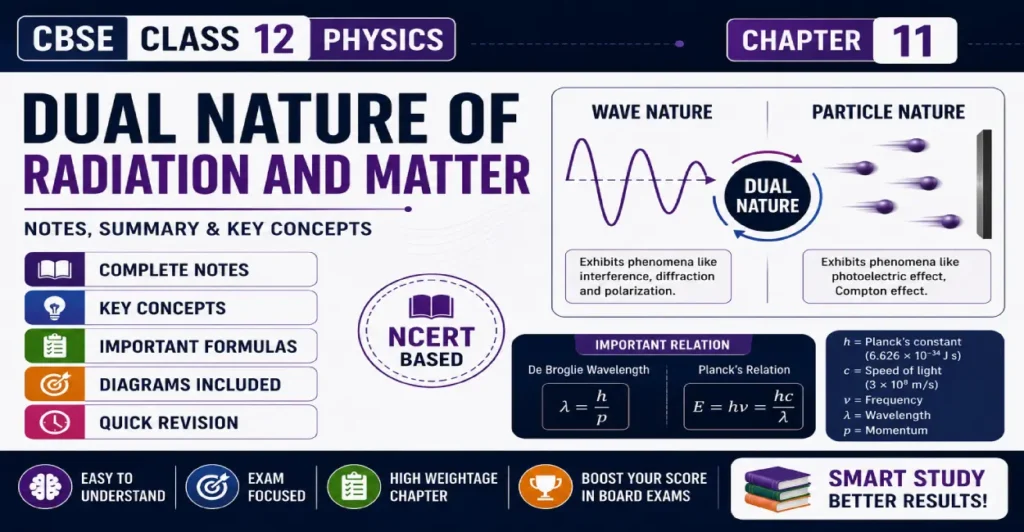
Dual Nature of Radiation and Matter is one of the most important chapters in CBSE Class 12 Physics. This chapter introduced a revolutionary idea in modern physics, that light and matter exhibit both wave and particle properties. The chapter explains the photoelectric effect, photon theory, Einstein’s photoelectric equation, de Broglie hypothesis, and matter waves.
Table of Contents
- Dual Nature of Radiation and Matter Class 12 Overview
- Dual Nature of Radiation and Matter Summary and Important Concepts
- Photoelectric Effect, Photon Theory and Einstein’s Equation Notes
- de Broglie Hypothesis and Matter Waves Notes
- Dual Nature of Radiation and Matter Formula Sheet, Important Terms and Revision Notes
- Important Terms and Definitions
- Formula Sheet
- Important Diagrams to Practice
- 5-Minute Revision Notes
- Common Mistakes Students Make
- Preparation Tips for Board Exams
- What is the dual nature of radiation and matter?
- What is the photoelectric effect?
- Who explained the photoelectric effect?
- What is de Broglie’s hypothesis?
- What is a photon?
- Why is the Dual Nature of Radiation and Matter chapter important?
- Is this chapter important for JEE, NEET, and CUET?
These Dual Nature of Radiation and Matter Notes are designed to help students understand concepts quickly and prepare effectively for school exams, unit tests, annual examinations, and CBSE board exams. Since this chapter forms the foundation of quantum physics, it is highly important for both board and competitive examinations.
Dual Nature of Radiation and Matter Class 12 Overview
| Particular | Details |
| Board | CBSE |
| Class | 12 |
| Subject | Physics |
| Chapter Number | 11 |
| Chapter Name | Dual Nature of Radiation and Matter |
| Important Topics | Photoelectric Effect, Photons, Einstein’s Equation, de Broglie Hypothesis |
| Exam Importance | Very High |
| Question Types Asked | Theory, Numericals, Derivations, Conceptual Questions |
Dual Nature of Radiation and Matter Summary and Important Concepts
Earlier, scientists believed that light behaved only as a wave. However, several experiments showed that light also behaves like particles. Similarly, matter particles such as electrons exhibit wave properties. This led to the concept of wave-particle duality.
The dual nature concept can be understood through the following examples:
| Entity | Wave Nature | Particle Nature |
| Light | Interference, Diffraction | Photoelectric Effect |
| Electron | Electron Diffraction | Mass and Momentum |
This chapter mainly covers:
- Wave nature of light
- Particle nature of light
- Photoelectric effect
- Photon theory
- Einstein’s photoelectric equation
- de Broglie hypothesis
- Matter waves
These discoveries completely changed the understanding of light and matter and laid the foundation of quantum mechanics.
One of the most important concepts in this chapter is the photoelectric effect. It refers to the emission of electrons from a metal surface when light of suitable frequency falls on it.
Important observations of the photoelectric effect:
- Photoelectric current increases with light intensity.
- Electron emission starts immediately after illumination.
- A minimum frequency is required for emission.
- Maximum kinetic energy depends on frequency, not intensity.
These observations could not be explained by classical wave theory and led to Einstein’s photon theory.
Photoelectric Effect, Photon Theory and Einstein’s Equation Notes
The minimum frequency required to eject electrons from a metal surface is called the threshold frequency.
Symbol:
ν₀
Important points:
- Different metals have different threshold frequencies.
- No photoelectric emission occurs below threshold frequency.
The minimum energy required to remove an electron from a metal surface is called the work function.
Formula:
Φ = hν₀
Where:
- Φ = Work Function
- h = Planck’s Constant
- ν₀ = Threshold Frequency
The photon theory proposed that light consists of tiny packets of energy called photons.
Properties of photons:
- Travel at the speed of light.
- Have energy and momentum.
- Have zero rest mass.
- Exhibit particle-like behavior.
Energy of a photon:
E = hν
Photon momentum:
p = h/λ
Where:
- E = Photon Energy
- p = Photon Momentum
- λ = Wavelength
Einstein successfully explained the photoelectric effect using photon theory.
Einstein’s Photoelectric Equation:
hν = Φ + Kmax
Alternative form:
Kmax = hν − Φ
Where:
- hν = Energy of Incident Photon
- Φ = Work Function
- Kmax = Maximum Kinetic Energy
Important points:
- Explains all experimental observations of the photoelectric effect.
- Shows that photon energy is divided into work function and kinetic energy.
- One of the most important equations in modern physics.
Stopping potential is another important concept.
Formula:
eV₀ = Kmax
Where:
- V₀ = Stopping Potential
- e = Electronic Charge
Stopping potential helps determine the maximum kinetic energy of emitted photoelectrons.
de Broglie Hypothesis and Matter Waves Notes
Louis de Broglie proposed that if light can show particle nature, then moving particles should also exhibit wave nature.
This idea is known as the de Broglie hypothesis.
Statement:
Every moving particle is associated with a wave.
The wavelength associated with a moving particle is called the de Broglie wavelength.
Formula:
λ = h/p
Since momentum p = mv,
λ = h/mv
Where:
- λ = de Broglie Wavelength
- h = Planck’s Constant
- m = Mass of Particle
- v = Velocity of Particle
Important points:
- Larger mass produces smaller wavelength.
- Smaller mass produces larger wavelength.
- All moving particles possess wave properties.
For electrons:
λ = h/√(2mE)
Where:
- m = Mass of Electron
- E = Kinetic Energy
The existence of matter waves was later confirmed experimentally through electron diffraction experiments.
Applications of matter waves:
- Electron Microscopes
- Electron Diffraction Studies
- Quantum Mechanics
- Semiconductor Technology
The de Broglie hypothesis is considered one of the most important contributions to modern physics because it established the wave nature of matter.
Dual Nature of Radiation and Matter Formula Sheet, Important Terms and Revision Notes
Important Terms and Definitions
| Term | Meaning |
| Photon | Packet of light energy |
| Photoelectric Effect | Emission of electrons by light |
| Photoelectron | Electron emitted from a metal surface |
| Threshold Frequency | Minimum frequency required for emission |
| Work Function | Minimum energy needed for emission |
| Stopping Potential | Potential required to stop photoelectrons |
| Matter Wave | Wave associated with a moving particle |
| de Broglie Wavelength | Wavelength associated with matter |
| Photon Momentum | Momentum carried by photon |
| Quantum | Smallest packet of energy |
Formula Sheet
| Formula Name | Formula |
| Photon Energy | E = hν |
| Photon Momentum | p = h/λ |
| Work Function | Φ = hν₀ |
| Einstein’s Equation | hν = Φ + Kmax |
| Maximum Kinetic Energy | Kmax = hν − Φ |
| Stopping Potential | eV₀ = Kmax |
| de Broglie Wavelength | λ = h/p |
| de Broglie Wavelength | λ = h/mv |
| Electron Wavelength | λ = h/√(2mE) |
Important Diagrams to Practice
Students should regularly practice:
- Photoelectric Effect Experimental Setup
- Photoelectric Cell
- Photoelectric Current vs Voltage Graph
- Photoelectric Current vs Intensity Graph
- Kinetic Energy vs Frequency Graph
- Stopping Potential Graph
- Photon-Metal Interaction Diagram
- Matter Wave Representation
5-Minute Revision Notes
- Light exhibits both wave and particle nature.
- Photon is a packet of electromagnetic energy.
- Photon energy = hν.
- Photoelectric effect proves particle nature of light.
- Threshold frequency is the minimum frequency required for emission.
- Work function = hν₀.
- Einstein’s equation explains the photoelectric effect.
- Intensity affects photoelectric current.
- Frequency affects kinetic energy.
- de Broglie proposed matter waves.
- de Broglie wavelength = h/mv.
- Every moving particle possesses wave nature.
Common Mistakes Students Make
- Confusing intensity and frequency effects.
- Mixing threshold frequency and work function.
- Using incorrect units in photoelectric calculations.
- Forgetting Einstein’s photoelectric equation.
- Confusing photon energy with kinetic energy.
- Using incorrect de Broglie wavelength formulas.
- Ignoring stopping potential concepts.
- Mixing examples of wave and particle nature.
Preparation Tips for Board Exams
- Learn all photoelectric effect observations carefully.
- Memorize Einstein’s photoelectric equation.
- Practice stopping potential numericals regularly.
- Understand threshold frequency and work function clearly.
- Revise photon properties thoroughly.
- Practice de Broglie wavelength problems.
- Study all NCERT graphs carefully.
- Solve previous year CBSE questions.
- Prepare a one-page formula sheet.
- Focus on conceptual understanding rather than memorization.
Dual Nature of Radiation and Matter is one of the most important chapters in modern physics. A strong understanding of photoelectric effect, photons, Einstein’s photoelectric equation, and de Broglie matter waves can help students score excellent marks in CBSE board examinations.
Last updated on

Sanjeev Gupta
Writes about exams, syllabus, date sheets and results for students across India.